
How to use interdental brush
The complete guide to cleaning between your teeth properly
Most people brush their teeth twice a day and call it done. A smaller number floss. An even smaller number use interdental brushes — and yet interdental brushes consistently outperform both floss and standard brushing when it comes to removing plaque from between the teeth.
The spaces between your teeth make up roughly 40% of the tooth surface that your toothbrush simply cannot reach. Every single day, plaque builds up in those spaces. Left undisturbed, that plaque hardens into tartar, triggers gum inflammation, and creates the conditions for the decay and gum disease that most people would very much like to avoid.
Interdental brushes fix this. But only if you are using the right size and the right technique.
This guide covers everything — how to use interdental brushes correctly, how to choose the right size, which spaces they suit, common mistakes to avoid, and — one of the most Googled questions on this topic — how many times can you reuse an interdental brush before it needs replacing.
At Face Dental in Coventry, this is the kind of practical guidance our dental hygienist goes through with patients at every appointment. Because great professional care and great home care work together — one does not replace the other.
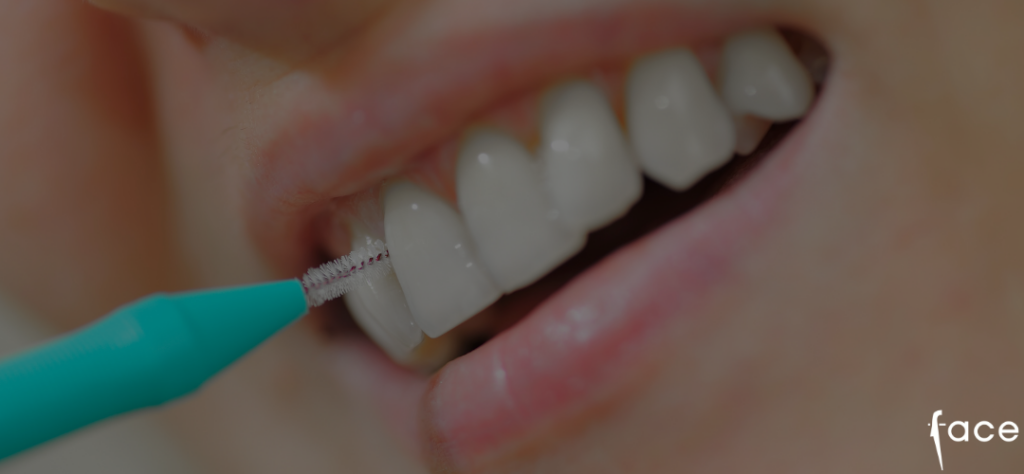
What exactly is an interdental brush?
An interdental brush — also called an interproximal brush or TePe brush (after the popular brand) — is a small, cylindrical brush on a short handle, designed to fit into the space between two adjacent teeth. Unlike dental floss, which cuts through the space in a sawing motion, an interdental brush fills the space and physically removes plaque from both tooth surfaces simultaneously, including just beneath the gum line where plaque does the most damage.
They come in a range of sizes, from very fine wire-mounted brushes for tight spaces to larger cylindrical versions for wider gaps. The size you need varies from space to space — and for most adults, different parts of the mouth need different brush sizes.
Choosing the right size — this matters more than most people realise
Using an interdental brush that is too small for a given space means it moves around without effectively cleaning the surfaces on either side. Too large, and it will not fit without forcing it — which risks damaging the gum tissue or the bone beneath.
The goal is a brush that fills the space with gentle resistance — it goes in, contacts both sides, and comes back out without significant force.
The standard sizing guide
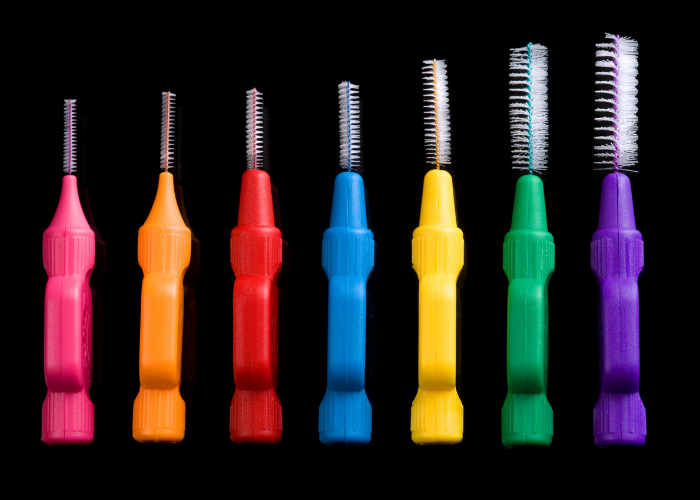
Most brands use a colour-coded size system. The most widely used in UK dental practice is the TePe Original sizing, though other brands (Curaprox, GUM, Oral-B) use similar conventions.
Colour | Wire diameter | Typical use case |
Pink | 0.4 mm | Very tight spaces, often lower front teeth |
Orange | 0.45 mm | Tight contacts, lower front and upper front teeth |
Red | 0.5 mm | Moderately tight spaces |
Blue | 0.6 mm | Most common all-round size for adults |
Yellow | 0.7 mm | Slightly wider contacts, common in back teeth |
Green | 0.8 mm | Wider spaces, especially lower molars |
Purple | 1.1 mm | Larger gaps, spaces around implants or bridgework |
Grey | 1.3 mm | Significant gaps, under bridges, around implants |
Many adults need different sizes in different parts of their mouth — blue for upper back teeth, pink for the lower front teeth, for example. This is normal and expected. Your dental hygienist can advise you on the exact sizes suited to each area of your mouth based on what they observe during your appointment.
How to use interdental brushes: the step-by-step technique
Getting this right is less complicated than it sounds — but a few specific details make a significant difference to both comfort and effectiveness.
Before you start
Use your interdental brushes before brushing, not after. This removes food debris and loosens plaque from between the teeth, so that when you brush with fluoride toothpaste, the fluoride can access the cleaned surface. If you use them after brushing, you wash away the fluoride that should be sitting on the enamel surface.
Step 1: Choose the right brush
Start with the size your hygienist has recommended, or with a size that fits the space with gentle resistance. For first-time users, a blue or red is a good starting point for most adult back teeth.
Step 2: The correct angle
For upper teeth, angle the brush slightly downward — aiming gently towards the gum rather than straight across. For lower teeth, angle slightly upward. This allows the brush to clean just beneath the gum margin, where the plaque that triggers gum disease tends to accumulate.
Step 3: Insert without forcing
Gently guide the brush into the space between two teeth. Do not force it. If it meets significant resistance, you need a smaller size. The brush should slide in with light pressure and sit flush against both tooth surfaces inside the space.
Step 4: Move it in and out — not round and round
Two to three in-and-out strokes per space is sufficient for each space. The cleaning happens through the contact of the filaments with the tooth surface and gum margin, not through vigorous scrubbing. A gentle, controlled motion is more effective and less likely to cause gum soreness.
Step 5: Rinse between spaces
After each space, rinse the brush under the tap to clear it of debris before moving to the next gap. This prevents bacteria and food particles from being transferred between spaces.
Step 6: Work systematically
Start at one end of the mouth and work through every space in sequence — upper left, upper right, lower right, lower left. Working systematically means you cannot accidentally skip a space. Most adults have 12 to 14 accessible spaces between the upper and lower teeth combined.
Step 7: Do not use toothpaste on the brush
Toothpaste is not recommended for use on interdental brushes. It creates foam that reduces visibility and makes it harder to feel whether the brush is sitting properly. Plain water is all you need — the mechanical action of the filaments is what removes the plaque, not the toothpaste.
How many times can you reuse an interdental brush?
This is one of the most common questions people have — and the answer is more nuanced than the packaging usually suggests.
How many times to reuse an interdental brush: the honest answer
Most manufacturers suggest replacing an interdental brush when the filaments are visibly splayed or when the wire shows any signs of bending or corrosion. In practice, this means:
- For users with normal spacing: 3 to 5 uses per brush is a reasonable guide
- For users with tighter spaces: filaments may splay after 2 to 3 uses
- For users with wider gaps: the brush may remain effective for up to a week of daily use
- A bent wire is the clearest signal that the brush should be retired — a bent wire risks scratching the root surface or damaging the gum
You can rinse and reuse an interdental brush within the same cleaning session — for example, using the same brush for all spaces in the upper arch and then the lower. Between sessions, rinse it well, allow it to dry in the open air (not stored in a sealed case while wet), and assess the filament condition before each use.
A note on hygiene: Bacteria do accumulate on used interdental brushes. Rinsing well after use and allowing to dry reduces this, but a brush that has been used for a week should always be replaced regardless of how it looks. Think of it like a regular toothbrush — the bacteria argument applies as much as the wear argument.
The honest practical recommendation: buy a multipack, which makes it easier to replace them regularly without the cost feeling significant. Many patients find keeping three to five at different sizes accessible makes the process feel less clinical and more habitual.
Interdental brushes versus dental floss — is one better?
This question comes up regularly, and the research is fairly clear on it: interdental brushes are more effective than floss at removing plaque and reducing gum bleeding in most patients, based on multiple systematic reviews and clinical trials.
The reason comes down to contact. Floss passes between the teeth and contacts the surfaces in a thin line. An interdental brush fills the space and contacts both surfaces simultaneously, including the slightly concave areas on the side of the tooth that floss does not reliably reach. It also makes better contact with the gum margin.
That said, floss is not without value:
- In very tight contacts where no interdental brush fits comfortably, floss may be the only option
- For younger people with tighter, undamaged interdental spaces, floss can be appropriate
- Some patients find floss easier to use in certain areas
The practical recommendation is: use interdental brushes where they fit. If a space is too tight for a brush — even the smallest available size — use floss there instead. A combination approach covers the full range.
If you are unsure which tool suits which part of your mouth, a dental hygienist appointment at Face Dental will clarify this in a few minutes based on a direct look at your teeth.
The most common mistakes — and how to fix them
- Using one size for the whole mouth Different spaces need different sizes. Committing to a single brush for the entire mouth typically means some spaces are not being cleaned effectively. Most adults benefit from two sizes.
- Forcing the brush in This is uncomfortable, often ineffective (the brush bends rather than cleaning), and can bruise the gum tissue. The brush should slide in gently. Resistance is a signal to try a smaller size.
- Skipping the back teeth The back teeth are where gum disease most commonly begins — partly because access is more difficult and cleaning is less thorough. They are also where spaces tend to be wider, meaning a larger brush is often needed specifically for the back of the mouth.
- Brushing back and forth instead of in and out A side-to-side scrubbing motion with an interdental brush is not more effective and often catches the filaments against the tooth edge. The in-and-out motion is what works.
- Using them only when gums bleed Many patients reach for interdental brushes when they notice bleeding gums, use them for a few days, stop when the bleeding reduces, and then do not use them again until the next episode. This is the wrong approach — bleeding gums improve with consistent cleaning, not occasional intervention. Daily use is what produces lasting improvement in gum health.
- Storing them wet Putting a used, wet interdental brush back into a sealed cap creates a warm, moist environment that bacteria thrive in. Rinse, shake off excess water, and leave to dry with the cap off.
What bleeding gums during interdental brushing actually mean
First-time interdental brush users often experience bleeding, which can be alarming enough to make them stop. This is understandable — but it is the opposite of the right response.
Healthy gum tissue does not bleed when cleaned. Gum tissue that bleeds when touched by an interdental brush is inflamed — almost always because plaque has been accumulating undisturbed in that space. The bleeding is a symptom of existing inflammation, not a sign that the brush is causing harm.
Consistent daily use of interdental brushes reduces that inflammation over one to two weeks, and the bleeding reduces with it. If bleeding persists beyond two weeks of daily cleaning, or is significant rather than minor, a dental check-up is worth booking — persistent bleeding can indicate gum disease that needs professional assessment and treatment.
When professional cleaning is part of the picture
How to use interdental brushes well is one component of good oral health. The other is professional care — because no matter how well you clean at home, tartar that has already formed above and below the gum line cannot be removed by any brush, interdental or otherwise.
Tartar (calculus) is hardened plaque that has mineralised and calcified onto the tooth surface. It is rough, porous and provides the ideal habitat for the bacteria that cause gum disease. The only way to remove it is through professional scaling — carried out by a dentist or dental hygienist with specialist instruments.
At Face Dental in Coventry, hygiene appointments include thorough scaling and polishing, a detailed assessment of gum health, and the kind of personalised home care guidance — including exactly how to use interdental brushes for your specific mouth — that makes every subsequent cleaning session more effective.
Led by Dr Abdul Osman GDC: 231996, whose international reputation in implant and restorative dentistry informs the clinical standard of the entire practice, Face Dental brings the same rigour to preventive care as to complex restorative work. A healthy mouth is the foundation on which everything else — whether that is composite bonding, veneers, implants or simply keeping your natural teeth — depends.
The bottom line
Good interdental cleaning is one of the most impactful things you can do for your long-term oral health. The teeth, the gums, the bone beneath — all benefit from consistent daily cleaning between the teeth that removes plaque before it can calcify and cause damage.
How to use interdental brushes is not complicated, but getting the size right, using the correct technique and replacing the brush regularly makes a real difference to effectiveness. How many times to reuse an interdental brush is typically three to five uses before the filaments splay — though the wire bending is always the clearest replacement signal.
Start with the sizes your hygienist recommends. Use them before brushing. Go gently. Work systematically. Replace regularly.
And if your gums bleed when you first start — keep going. That is your mouth telling you the cleaning was overdue.
For dental check-ups, hygiene appointments or any other dental concern, Face Dental is at 76 Quinton Rd, Coventry, CV3 5FD — call 02476 501 125 or get in touch online.
Disclaimer
The information in this article is intended for general educational guidance only and does not constitute personalised dental advice. For concerns about your gum health or guidance on interdental cleaning specific to your mouth, please book an appointment with a qualified dental professional.
Face Dental is a private dental practice at 76 Quinton Rd, Coventry, CV3 5FD — a family legacy built on two generations of expertise, led by Dr Abdul Osman GDC: 231996, international lecturer and key opinion leader for Bredent copaSKY implants and Meisinger surgical instruments. We offer dental check-ups, hygiene appointments, composite bonding, Invisalign, porcelain veneers, teeth whitening, dental implants, dental crowns, smile makeovers, facial aesthetics and emergency appointments. Call 02476 501 125 or contact us online.
Frequently asked questions
How to use interdental brushes if my gums bleed?
Bleeding when you first start using interdental brushes is normal and expected if the spaces have not been cleaned regularly. It is caused by inflammation from existing plaque build-up — not by the brush causing damage. Continue daily use with a gentle technique and the bleeding should reduce significantly within one to two weeks as the gum inflammation settles. If bleeding is heavy or persists beyond two weeks, book a dental check-up to rule out more significant gum disease.
How many times to reuse an interdental brush before replacing it?
Three to five uses is a reasonable guide for most patients with standard spacing. The clearest signal that replacement is needed is when the filaments become visibly splayed or the wire begins to bend — a bent wire can scratch root surfaces and should be retired immediately. Rinse after each use, allow to dry in open air, and replace the brush regardless of apparent condition after about a week of daily use. Buying multipacks makes regular replacement feel less significant.
Should I use interdental brushes before or after brushing?
Before brushing. Using interdental brushes first loosens and removes plaque from between the teeth, allowing your fluoride toothpaste to access those surfaces when you subsequently brush. If you use them after brushing, you displace the fluoride that should be sitting on the enamel surfaces. The sequence is: interdental brush, then toothbrush with fluoride toothpaste, spit but do not rinse with water.
How do I know what size interdental brush to use?
The right size fills the space between the teeth with gentle resistance — it goes in and out smoothly without forcing, and you can feel the filaments contacting both tooth surfaces. A brush that slides around loosely is too small; one that requires pushing is too large. Most adults need different sizes in different parts of the mouth. Your dental hygienist at Face Dental can assess your spaces during an appointment and recommend the exact sizes needed for each area.
Can I use interdental brushes around dental implants, crowns or bridgework?
Yes — and in fact, cleaning around implants and bridgework is one of the situations where interdental brushes are particularly important. Plaque removal around implant margins and under bridge pontics requires careful access that standard brushing cannot provide. The brush size needed around implants is often larger (purple or grey in the standard sizing), as the gap at gum level tends to be wider. If you have implants, a crown or a bridge at Face Dental, ask at your next hygiene appointment for guidance on the most effective cleaning approach for your specific restorations.